Navigating the complex landscape of SAP cybersecurity solutions. Compare Layer Seven Security against SAP Enterprise Threat Detection (SAP ETD), Onapsis, Pathlock, and SecurityBridge across 20+ critical criteria.
For organizations managing mission-critical SAP landscapes, selecting a cybersecurity partner requires balancing depth of coverage with total cost of ownership (TCO). In a direct evaluation of 20 industry-standard criteria, including Vulnerability Analysis, Threat Detection, Anti-Ransomware and SIEM Integration, the Cybersecurity Extension for SAP by Layer Seven Security is the only solution to satisfy every requirement.
While competitors like Onapsis and SAP Enterprise Threat Detection (SAP ETD) require significant infrastructure and complex licensing, Layer Seven Security offers a lightweight, agentless, and SAP-certified platform that provides full-stack protection with the lowest TCO in its class.
Use this table to compare the depth and breadth of coverage across leading SAP cybersecurity platforms based on 20 specific technical and operational criteria.
| Layer Seven Security | SAP | Onapsis | Pathlock | SecurityBridge | |
|---|---|---|---|---|---|
| Vulnerability Analysis | |||||
Vulnerability analysis is the process of hardening SAP solutions by identifying, evaluating, and removing security weaknesses that could be exploited by threat actors to compromise systems. SAP is the only vendor in this evaluation that does not provide a commercial solution with coverage for system vulnerability analysis. SAP Enterprise Threat Detection (SAP ETD) supports primarily threat detection, SAP CVA is specifically for custom code vulnerability management. Limited support for system vulnerability analysis is provided by SAP through Cloud ALM. However, the coverage is restricted to basic health checks in the SAP Security Baseline. Solutions from third party vendors perform a greater volume of vulnerability checks and therefore provide a higher level of protection. For example, the Cybersecurity Extension for SAP from Layer Seven Security includes more than 5000 checks for vulnerabilities in SAP solutions. | |||||
| Security Patch Management | |||||
Security patch management is the process of reviewing, prioritizing, and applying SAP’s official security updates – known as SAP Security Notes – to fix vulnerabilities and strengthen system protection. Each month, SAP releases Security Notes that address newly discovered weaknesses or misconfigurations in its software. Organizations must analyze these notes to determine which are relevant to their systems, assess the risk and impact, and then implement the necessary patches or configuration changes. Security Notes are reported by to customers SAP via the SAP Support Portal. Third party security solutions automate the discovery and lifecycle management of Security Notes, The Cybersecurity Extension for SAP calculates relevant notes for each SAP solution based on installed software components and versions and the implementation status of existing notes. Layer Seven Security also provide virtual patches for many critical hot news and high priority security notes when official patches cannot be applied. | |||||
| Compliance Management | |||||
Security compliance management for SAP solutions is the process of ensuring that SAP systems meet internal security policies, industry standards, and regulatory requirements. It involves continuously auditing, assessing, and documenting SAP security controls to demonstrate that the environment is configured and operating securely. SAP ETD and SAP CVA do not support compliance management for SAP solutions. Third-party solutions provide varying degrees of coverage. The Cybersecurity Extension for SAP performs automated compliance monitoring for 15 frameworks including GDPR, NIST, PCI-DSS, and SOX, as well as SAP standards such as the SAP Security Baseline, Security Guide for S/4HANA and Mandatory Security and Hardening Requirements for SAP RISE. | |||||
| Custom Code Security | |||||
SAP systems often include custom code such as ABAP programs and UI5 applications that extend standard SAP functionality. Insecure custom code can provide an entry point for attackers, even in SAP systems that are fully hardened and patched. Common risks include SQL injection, authorization bypass, malicious command execution, and sensitive data exposure. Manual code review is time-consuming and error-prone. Automated static and dynamic scanning for custom code in SAP systems can detect vulnerabilities more effectively and efficiently, and enforce consistent standards for secure development. Layer Seven Security integrate with SAP development tools such as the ABAP Test Cockpit (ATC) to detect 500+ vulnerabilities in custom ABAP and UI5 code. It also integrates with the SAP Transport Management System (TMS) to automatically scan and block transports with security errors and warnings. Periodic scans can be scheduled to detect and assess changes in custom code deployed in productive systems. | |||||
| Access Risk Analysis for S/4HANA & SAP ECC | |||||
Enterprise Resource Planning (ERP) solutions such as SAP ECC and SAP S/4HANA automate and integrate core business processes such as finance, HR, manufacturing, and supply chain management into single unified systems. Controlling end-user access across multiple integrated modules and large user bases in such solutions is a complex and continuous challenge. Access must be granted to end users in accordance with business needs and the principles of least privilege and Segregation of Duties (SoD). The Cybersecurity Extension for SAP is the only solution in the evaluation that detects users with critical permissions and SoD violations across both SAP ECC and SAP S/4HANA. Coverage spans key business modules including Finance (FI), Controlling (CO), Sales and Distribution (SD), Materials Management (MM), Production Planning (PP), and Human Capital Management (HCM). The solution also supports periodic access reviews for SAP to maintain compliance with audit standards. The functionality is included in the standard license for the Cybersecurity Extension for SAP. In contrast, SAP and Pathlock require separate tools for access risk analysis. This capability is absent from the cybersecurity offerings from Onapsis and SecurityBridge. | |||||
| Threat Detection | |||||
Malicious activity targeting SAP systems leaves identifiable traces in system and user logs. By continuously monitoring these logs and applying effective threat detection and response, organizations can identify and contain attacks early, preventing them from spreading and compromising critical SAP systems. With the exception of SAP CVA, the solutions in this evaluation support real or near time log collection and analysis with predefined rules for detecting Indicators of Compromise (IoC). The Cybersecurity Extension for SAP stands-out with the highest number of predefined rules and coverage for application, database and OS logs for cross-stack monitoring in SAP systems. This includes 1200+ patterns for the Gateway Server Log, Message Server Log, HTTP Log, Read Access Log, System Log, and STAD in ABAP systems, the Security Log in SAP Java, and logs for the SAProuter, Web Dispatcher, Cloud Connector, and SAP BTP. For database monitoring, the Cybersecurity Extension supports the Audit Log in SAP HANA, and security logs for SAP ASE, Oracle, IBM DB2 and Microsoft SQL Server. Supported OS logs include Red Hat Enterprise Linux (RHEL), SUSE Linux Enterprise (SLES), and Microsoft Server. | |||||
| Anomaly Detection | |||||
Anomaly detection can identify unusual or abnormal behavior in systems that may indicate a security threat or compromise. The majority of the solutions in this class use analytics or machine learning to detect anomalies that deviate from established baselines for systems and users. For example, the Cybersecurity Extension for SAP analyzes event data against normalized patterns of behavior to calculate security-related anomalies. | |||||
| AI-Powered Security Analysis | |||||
AI agent integration enables security teams to analyze SAP vulnerabilities, threats, compliance requirements, security notes, and access risks using natural language. CES provides AI assistants and agents with access to SAP security intelligence using MCP, allowing them to generate actionable insights, recommendations, and automated workflows based on real-time security data from across the SAP landscape. | |||||
| Anti-Ransomware | |||||
The impact of ransomware in SAP solutions can be devastating. Compromised solutions can paralyze business processes, disrupt supply chains, and lead to significant financial losses. Effective anti-ransomware for SAP combines application, database and OS hardening, continuous monitoring of SAP application and infrastructure logs, and anomaly detection to identify early signs of malicious activity. The Cybersecurity Extension for SAP supports system hardening for anti-ransomware by identifying vulnerable settings and services that may be exploited to perform ransomware attacks. It also identifies users with privileges to download, install and execute programs in SAP applications. The Cybersecurity Extension for SAP detects and alerts for the execution of OS commands associated with ransomware exploits, suspicious HTTP and RFC calls, root commands and Sudo actions in SAP hosts, and changes in file systems that may indicate successful or unsuccessful attempts to install malware. | |||||
| Incident Response | |||||
Effective incident response can dramatically reduce the impact of cyber attacks by containing security threats, limiting data loss and minimizing system downtimes. Early containment prevents threat actors from escalating attacks, moving laterally and compromising sensitive data. It also ensures SAP systems supporting critical business processes remain resilient and recover quickly. Cybersecurity solutions for SAP support effective response by detecting and alerting for security incidents. Often the solutions trigger notifications such as alarms and emails for alerts. They also support forensic investigation of security incidents. However, few of the solutions provide structured workflows for investigating, documenting and reporting on incidents. The Cybersecurity Extension for SAP provides automated workflows and best practices for investigating security alerts and support Security Orchestration, Automation, and Response (SOAR). It empowers non-technical and non-experts to effectively investigate security incidents for SAP solutions with predefined step-by-step instructions to analyze, respond, report, and close security alerts. | |||||
| Security Forensics | |||||
Investigating suspicious or malicious activity is critical to support effective incident response and identify the source and impact of security events in SAP systems. Cybersecurity solutions enable forensic analysis by collecting, standardizing and centralizing event data from SAP logs for review. This supports root cause analysis, event reconstruction and impact assessment. Users can apply complex queries to analyze events across multiple logs and systems. Some solutions, such as the Cybersecurity Extension for SAP, also support the creation of custom alarms for events during forensic investigations. The Cybersecurity Extension for SAP also enables users to maintain exclusions for events to customize and tune security alerts and prevent alert flooding. It also archives event data in a separate system to protect against anti-forensics performed by threat actors in compromised systems. Anti-forensics can obscure, hide, or remove traces of malicious activity in monitored systems. | |||||
| SIEM Integration | |||||
Integrating SAP security logs with SIEM (Security Information and Event Management) solutions improves visibility, detection, and response capabilities. It also enables organizations to correlate events in SAP systems with events from other assets and endpoints. This supports end-to-end monitoring and reconstruction of incidents for IT landscapes. Direct integration of SAP logs with SIEM solutions presents several challenges. SAP systems generate numerous logs, each with its own format and event structure. The logs often produce a high volume of Events Per Second (EPS), and many lack key information needed to support event correlation in SIEM platforms. Solutions such as the Cybersecurity Extension for SAP enable organizations to address these challenges by providing a single integration point between SAP environments and SIEM platforms. This allows customers to maintain just one data source in their SIEM to collect information from all SAP logs and systems, simplifying both initial setup and ongoing maintenance. Additionally, the Cybersecurity Extension filters and enriches SAP events before they are sent to SIEM platforms, reducing event volume and improving correlation. The Cybersecurity Extension for SAP supports integration with any SIEM solution that ingests file-based logs and syslog. This includes Splunk, Logpoint, Sentinel, AlienVault, LogRhythm, QRadar and ArcSight. | |||||
| Interface Monitoring | |||||
SAP systems rarely operate in isolation. They continuously exchange data with other applications, databases, third-party systems, and external partners. The exchange is performed using numerous interfaces including RFC, IDoc, BAPI, OData, web service, and other protocols. Threat actors can exploit insecure connections for interfaces configured with missing or weak authentication and encryption. The Cybersecurity Extension for SAP detects insecure interfaces in SAP systems including RFC destinations configured with privileged users and inadequate encryption. It also identifies systems using weak encryption algorithms or with insufficient restrictions for accessing Remote Function Modules (RFM). This includes settings for Unified Connectivity (UCON). The solution also detects misconfigurations in the gateway server, message server and Internet Communication Manager (ICM) and alerts for successful and unsuccessful calls to vulnerable programs, reports, ICF services and RFMs. | |||||
| Configuration Drift | |||||
SAP environments are highly dynamic, undergoing continuous changes to align with evolving business needs. These changes may involve applying patches and updates to deliver enhancements and fixes, modifying or introducing custom developments, implementing new interfaces to enable cross-system integration, and adjusting user roles and permissions. Uncontrolled changes can undermine security hardening and expose SAP systems to hidden risks. Solutions such as the Cybersecurity Extension for SAP mitigate the risk by detecting, reporting and alerting for changes that impact security hardening. This includes changes to security-related dynamic and static parameters in ABAP systems and database changes in SAP HANA. It also includes changes to custom code, system interfaces, and roles, profiles and authorizations assigned to SAP users. | |||||
| Transport Monitoring | |||||
Change control in SAP landscapes is managed using the SAP Transport Management System (TMS). The TMS ensures that configuration, code, and other changes are migrated in a controlled, consistent, and auditable manner through transport requests, reducing the risk of errors or inconsistencies between environments. The Cybersecurity Extension for SAP enforces TMS-based change control by continuously monitoring SAP systems for unauthorized modifications, including dynamic changes to code in production systems. It analyzes transport requests for security vulnerabilities and automatically blocks any request containing errors or warnings, supporting change governance and system integrity across the SAP landscape. | |||||
| Database & OS Monitoring | |||||
SAP systems are not standalone applications. They are ecosystems comprised of application, database and host layers. The application layer supports the business logic. The database layer stores transactional and master data, system tables, logs, and configuration data. The host or operating system layer provides the runtime environment for SAP applications and the database. The layers are tightly integrated with trust relationships that can be exploited by threat actors to move laterally from compromised databases and hosts to applications or in reverse. The Cybersecurity Extension for SAP is the only solution that secures the entire SAP system stack including application, database and host layers. The solution supports vulnerability scanning and threat detection for SAP applications, database and hosts. The Cybersecurity Extension for SAP is the only solution that protects the full SAP system stack, including application, database, and host layers. It provides comprehensive vulnerability scanning and threat detection for both SAP and underlying infrastructure, ensuring no area is left exposed. | |||||
| User Experience | |||||
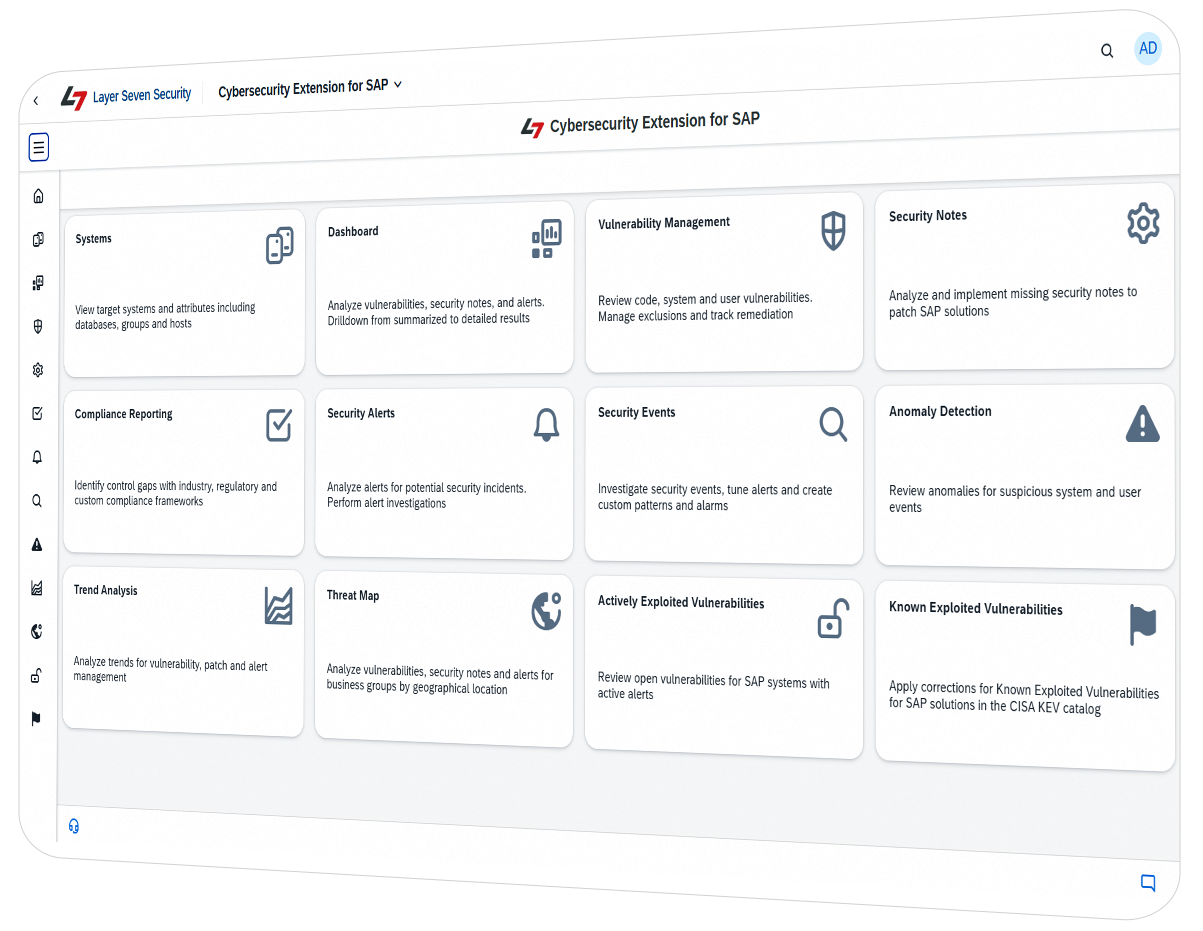
The user experience is important for SAP cybersecurity solutions since even the most powerful platforms can fail if they are difficult to use or unresponsive. Security tools with intuitive interfaces and clear workflows are more likely to be used consistently by employees. Complex or confusing tools may be bypassed, ignored, or misconfigured, leaving organizations vulnerable. Clear dashboards, alerts, and guidance help security teams quickly identify and remediate risks. An effective user experience ensures that critical actions are simple and unambiguous, minimizing mistakes, improving response times and reducing the need for extensive training. Solutions such as the Cybersecurity Extension for SAP provide a responsive, intuitive, and user-friendly design using an SAP Fiori interface. Fiori applications are web-based and mobile-friendly. They emphasize clarity, consistency, and ease of use. Fiori tiles, dashboards and apps deliver a roles-based user experience that can be customized for each user. Custom Fiori applications in the Cybersecurity Extension for SAP integrate seamlessly with standard SAP applications since they share the same platform and user framework. Fiori applications are more intuitive for SAP users, leading to quicker onboarding. | |||||
| Support for SAP RISE/ SAP Cloud ERP | |||||
There is a shared model of responsibility between SAP and customers for RISE with SAP/ SAP Cloud ERP Private Edition. Infrastructure security is managed by SAP, whereas customers are responsible for the application and data layer. Unless customers purchase additional packages and services from SAP Enterprise Cloud Services (ECS) that are not included in standard RISE/ Cloud ERP contracts, organizations are accountable for managing user access, system settings, custom code, application security notes, and security incidents. All cybersecurity solutions in the evaluation can be effectively implemented by SAP RISE / Cloud ERP customers, even within the software and system constraints imposed by SAP ECS. For example, the Cybersecurity Extension for SAP can be deployed as an SAP-certified addon in RISE / Cloud ERP solutions, including SAP S/4HANA. The Cybersecurity Extension for SAP enables organizations to automate compliance audits for security requirements mandated by SAP Enterprise Cloud Services for RISE/ Cloud ERP solutions. | |||||
| SAP Certification | |||||
SAP certification for third-party solutions provides assurance that solutions are compatible, secure, and fully supported within SAP environments. Certification indicates that vendor have met SAP standards for integration, reliability, and best practices. SAP-certified products are tested to integrate seamlessly with SAP solutions and reduce the risk of system conflicts, errors, or performance issues. Certification also includes security assessments for adherence to SAP development standards. With one notable exception, the third-party cybersecurity solutions in the evaluation are certified by SAP. Certification is not relevant for the SAP solutions ETD and CVA. The Cybersecurity Extension for SAP has been SAP-certified since March 2021. | |||||
| Rapid Deployment | |||||
Shorter deployment times for SAP cybersecurity solutions leads directly to lower installation costs and faster adoption, reducing the window of vulnerability. Easier maintenance can also reduce the window of vulnerability by supporting more rapid updates with minimal system downtime. Products such as Onapsis and SAP ETD require additional servers and infrastructure. This can lead to longer deployments and more extensive maintenance. Updates for SAP ETD, for example, often require OS upgrades and HANA updates before ETD itself can be updated. Solutions such as the Cybersecurity Extension for SAP are lightweight addons for SAP. Consequently, they do not require additional servers and infrastructure and can be deployed within a few hours. They are also relatively easy to maintain since they are updated using SAP standard tools for addon updates. | |||||
| Licensing Cost | |||||
Licensing cost is a key factor when evaluating SAP cybersecurity solutions since it directly impacts both the total cost of ownership (TCO) and the sustainability of cybersecurity programs. Costly solutions are difficult to sustain and scale in organizations, regardless of their technical strength. Software vendors often divide their products into separate modules or units tailored for different use cases to make them appear more affordable and accessible. However, this approach can cause cost-conscious customers to compromise on coverage and functionality in favor of a lower price. The Cybersecurity Extension for SAP is an integrated solution that combines SAP vulnerability management, compliance reporting, access risk analysis, patch management, custom code security, and threat detection and response within a single, unified, and competitively priced platform. This enables organizations to minimize costs without compromising on coverage. | |||||
Many organizations evaluate native tools like SAP Enterprise Threat Detection (ETD) and SAP Code Vulnerability Analyzer (CVA). While these tools offer basic functionality, they often present significant infrastructure and coverage gaps.
Unlike SAP ETD, which requires additional Linux servers and a dedicated SAP HANA database, the Cybersecurity Extension is a lightweight addon that deploys in hours using standard SAP tools.
While SAP CVA focuses strictly on ABAP code, Layer Seven Security extends protection to UI5 and SAPUI5 applications.
Layer Seven Security integrates with the Transport Management System (TMS) to automatically block vulnerable code from reaching production—a capability absent in standard CVA.
Native SAP tools are often licensed as separate units. Layer Seven Security provides vulnerability management, patch management, and threat detection in one integrated platform.
While SAP provides basic health checks via Cloud ALM, the Cybersecurity Extension includes over 5,000 automated checks for system weaknesses.
We automate the discovery of SAP Security Notes and calculate relevance based on your specific software version—even providing workarounds when official patches cannot be applied.
We mitigate risk by alerting for changes in dynamic/static parameters in ABAP and SAP HANA that could undermine your hardening efforts.
We detect insecure RFC, OData, and Web Service connections that threat actors exploit to “hop” through your landscape.
With over 1,200 predefined patterns across Gateway, Message Server, and BTP logs, we offer the industry’s highest level of predefined rules.
We are unique in our ability to identify users with privileges to install programs and detect the execution of OS commands associated with ransomware exploits.
Unlike many tools that just “alert,” we provide structured workflows and SOAR support to empower non-experts to investigate incidents with step-by-step instructions.
Our solution integrates with ABAP Test Cockpit (ATC) to detect 500+ vulnerabilities and enforces change governance by blocking transports with security errors.
We are the only solution in this evaluation that detects users with critical permissions and SoD violations across both SAP ECC and S/4HANA within a single, unified license.
We monitor the SAP Transport Management System (TMS) for unauthorized modifications, including dynamic changes to code in production.
SAP is an ecosystem of applications, databases, and operating systems—not a standalone app.
We are the only solution that secures the entire stack, providing vulnerability scanning for the database (HANA, Oracle, SQL Server) and the OS (Linux, Windows).
We serve as a single integration point for Splunk, Sentinel, and QRadar, filtering and enriching SAP events to reduce volume and improve correlation.
While competitors require new servers, our lightweight addon can be deployed within a few hours with agentless installation.
We are fully compatible with SAP RISE solutions and automate compliance audits for the mandatory security requirements of SAP Enterprise Cloud Services (ECS).
We utilize a responsive SAP Fiori interface, ensuring the design is intuitive for SAP users requiring minimal training.
Layer Seven Security offer a simpler and faster path to protection than Onapsis through agentless deployment without additional infrastructure, easier long-term maintenance through backward-compatible add-ons, and broader cross-system protection across the application, database, and host layers. Its also provides a unified platform that combines vulnerability management, patch management, custom code security, access control analysis, and threat detection under a single license and a familiar SAP Fiori interface that minimizes training requirements. Onapsis does not support critical access and segregation of duties analysis for business users in SAP S/4HANA.
Layer Seven Security provides broader security coverage than SAP ETD by combining vulnerability management, patch management, compliance management, custom code scanning, access control analysis and threat detection in a single unified solution. SAP ETD does not provide this coverage. Layer Seven Security also has more a simplified architecture that avoids requirements for additional infrastructure. This leads to faster and less costly deployments and easier maintenance. SAP ETD does not support critical access and segregation of duties analysis for business users in SAP S/4HANA.
Layer Seven Security provides broader security coverage than SAP CVA by combining vulnerability management, patch management, compliance management, custom code scanning, access control analysis and threat detection in a single unified solution. SAP CVA does not provide this coverage. Layer Seven Security also includes more test cases for assessing the security of custom ABAP code than CVA. Finally, unlike Layer Seven Security, CVA does not support code vulnerability analysis for custom SAP UI5 applications. SAP CVA does not support critical access and segregation of duties analysis for business users in SAP S/4HANA.
Layer Seven Security provides broader security coverage than SAP Cloud ALM by combining vulnerability management, patch management, compliance management, custom code scanning, access control analysis, and threat detection in a single unified solution. Cloud ALM does not provide this coverage. Cloud ALM provides limited coverage for basic security health checks. It does not provide advanced cybersecurity protection for SAP solutions.
Layer Seven Security and SecurityBridge are both ABAP addons that provide a unified platform for SAP cybersecurity using a Fiori interface. However, Layer Seven Security provides greater coverage in terms available system, user and code vulnerability checks, and threat detection patterns. SecurityBridge does not support critical access and segregation of duties analysis for business users in SAP S/4HANA. Layer Seven Security also provide a more competitive licensing model, leading to lower costs.
Layer Seven Security provides a unified platform for SAP cybersecurity covering vulnerability management, patch management, compliance management, custom code scanning, access control analysis and threat detection. Pathlock require licensing of multiple modules to achieve the same coverage. Layer Seven Security also provides greater coverage in terms available system, user and code vulnerability checks, and threat detection patterns.
Layer Seven Security stands out as the strongest overall choice for SAP cybersecurity because it delivers the broadest protection in a single, integrated platform, combining vulnerability management, patch and compliance management, custom code scanning, access control analysis, and threat detection without the added complexity of multiple tools or modules. Compared with alternatives such as Onapsis, SAP ETD, SAP CVA, Cloud ALM, SecurityBridge, and Pathlock, it offers faster and simpler deployment, lower infrastructure and licensing overhead, broader coverage across application, database, and host layers, stronger support for SAP UI5 and ABAP code security, and the added ability to identify critical access and segregation of duties risks for business users in SAP S/4HANA.
We have supported many organizations in transitioning from other SAP security products to the Cybersecurity Extension for SAP through a structured and low-risk switching process designed to avoid gaps in coverage or disruption to security operations. This includes planning the migration of key use cases and controls, aligning equivalent or enhanced coverage for vulnerability management, compliance, code security, access risk analysis, and threat detection, and validating outputs before legacy tools are retired. As a result, customers can move to the Cybersecurity Extension for SAP in a controlled manner while maintaining continuity in monitoring, reporting, and protection throughout the transition.
Discover how a $55 billion beverage company with 170,000 employees worldwide reduced licensing costs by 50% by switching from a leading competitor to Layer Seven Security.
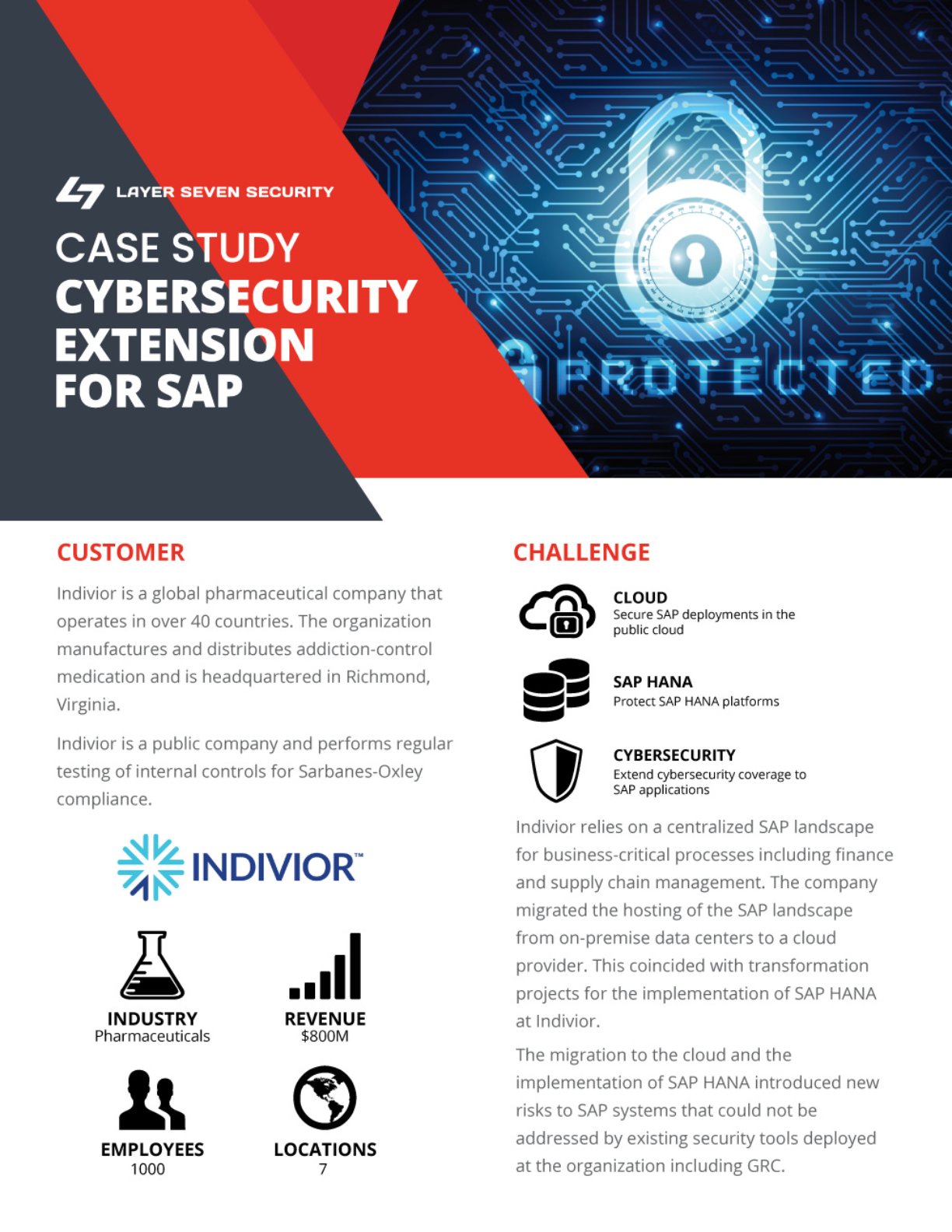
Learn how a global pharmaceutical company secured the migration of SAP solutions to the public cloud with Layer Seven Security.
Get the detailed side-by-side breakdown of Layer Seven Security, SAP Enterprise Threat Detection, SAP Code Vulnerability Analyzer, Onapsis, Pathlock, and SecurityBridge.

4.3 / 5
Major advantage of the SAP cybersecurity extension is the native integration with SAP’s protocols like RFC calls. Its deep integration enables more accurate detection with fewer false positives.
– General Management | Firm size: 250M – 500M USD | Industry: IT Services
See for yourself why world-class organizations trust Layer Seven Security to protect their mission-critical SAP systems. Schedule a live demonstration of the Cybersecurity Extension for SAP to explore our unified vulnerability management, threat detection, and compliance automation with AI-powered security analysis.
"*" indicates required fields