
Artificial Intelligence for SAP Security

Integrate SAP security intelligence with Copilot, Claude, Joule and other MCP-compatible AI assistants using the Cybersecurity Extension for SAP.

EXECUTIVE SUMMARY

Convert Your AI Assistant into an SAP Security Advisor

The Cybersecurity Extension for SAP (CES) brings the power of AI for SAP security, enabling organizations to turn complex security data into fast, meaningful answers. Using the open Model Context Protocol (MCP), CES connects with leading AI assistants such as Microsoft 365 Copilot, Anthropic Claude, and SAP Joule, allowing users to ask questions in natural language and instantly gain insights into SAP vulnerabilities, security notes, alerts, access control issues, security events, anomalies, compliance findings, and overall security posture.

With CES, organizations are not tied to a single AI platform. One secure, vendor-neutral connection provides access to SAP security intelligence across multiple AI assistants. This means consistent answers, centralized governance, and a common security foundation, without the cost and complexity of building separate integrations for every AI solution.

CES also gives customers complete deployment flexibility. It can run on SAP BTP to support cloud-based AI services or remain fully within the corporate network where greater control is required. The result is a future-ready approach to AI-powered SAP security: organizations can use the AI platforms they prefer while retaining control of their data, maintaining consistent governance, and ensuring security insights remain trusted, traceable, and auditable.

What is the Model Context Protocol?

The Model Context Protocol (MCP) is an open standard designed to make it easier for AI assistants to work with trusted business information and enterprise applications. MCP acts as a universal connection for AI, allowing AI platforms to access approved data and capabilities through a consistent, controlled framework.

For organizations, this removes much of the complexity traditionally associated with connecting AI to business systems. Instead of creating and maintaining a separate integration for every AI assistant, MCP enables a single connection that can support multiple compatible platforms. This helps accelerate AI adoption, reduce integration effort, and gives organizations greater freedom to choose the AI solutions that best fit their users and business strategy.

CES uses the MCP as a secure, standardized gateway between SAP security data and AI assistants such as Copilot, Claude, and SAP Joule. Users ask questions in natural language, and the assistant converts them into governed CES requests for SAP security insights.

Bring Your Own AI

Connect to Copilot, Claude, Joule, and other MCP-compatible AI assistants through a single open, reusable integration.

Cloud and Enterprise Deployment

Deploy to the cloud using SAP BTP or within corporate networks for greater infrastructure control.

Connect Insights to Action

Transform SAP security insights into reports, emails, documents, and workflows using AI agents.

Ask Questions. Uncover Risks. Respond Faster

CES connects SAP security intelligence to AI assistants through MCP, enabling users to investigate findings using natural-language prompts. It reveals security vulnerabilities across access controls, custom code, application configurations, databases, and hosts, while identifying relevant SAP security notes and analyzing events, alerts, and behavioral anomalies for threat detection. CES also highlights gaps against SAP and regulatory frameworks, including RISE security requirements, the SAP Security Baseline, the S/4HANA Security Guide, SOX, GDPR, NIST, and PCI DSS.

With CES, SAP security intelligence becomes as easy to access as asking a question in AI assistants. Users can interact with CES through their preferred AI assistant using natural-language prompts such as: “Show me all critical vulnerabilities affecting production systems,” “Are any of our systems exposed to OVERPASS?”, “Which critical SAP security notes are still outstanding?”, “Which alerts need immediate attention?”, “Show high-severity anomalies from the last 24 hours,” or “Do we have any compliance gaps for the SAP Security Baseline?”

CES delivers relevant, contextual security insights directly into the conversation, helping teams move faster from question to action. Rather than manually searching across reports and dashboards, users can quickly identify risks, investigate issues, guide remediation, support compliance activities, and generate meaningful security insights for both technical teams and executives.

SAP Vulnerabilities

Analyze and prioritize SAP security vulnerabilities across applications, custom code, access controls, databases, and hosts.

SAP Security Notes

Identify and manage relevant, unapplied SAP security patches by systems, components, CVE, and CVSS information.

Threat Detection & Response

Investigate SAP security events, alerts, and anomalies and perform guided incident investigations.

Compliance Management

Discover and remediate compliance gaps for SAP security standards and frameworks.

Frequently Asked Questions about Artificial Intelligence for SAP Security

What is the Model Context Protocol?
The Model Context Protocol, or MCP, is an open standard that connects AI assistants with external tools and trusted data through a consistent interface. CES uses MCP to make SAP security capabilities accessible through natural-language conversations without requiring a separate integration for every AI platform.
How does CES use MCP?
CES provides a governed MCP Server that translates requests from AI assistants into queries against existing CES services. Users ask questions in natural language, the AI assistant selects the appropriate CES capability, and the MCP Server retrieves the relevant SAP security information. No separate SAP-side data model or new ABAP backend logic is required.
Which AI assistants can connect to CES?
The same CES MCP deployment supports Microsoft 365 Copilot, Claude Desktop, Claude Code, and SAP Joule, as well as other current or future MCP-compatible clients. This open approach reduces dependence on proprietary connectors and avoids rebuilding the SAP integration for every AI platform.
What SAP security data can AI assistants access through CES?

Connected assistants can access CES capabilities covering:

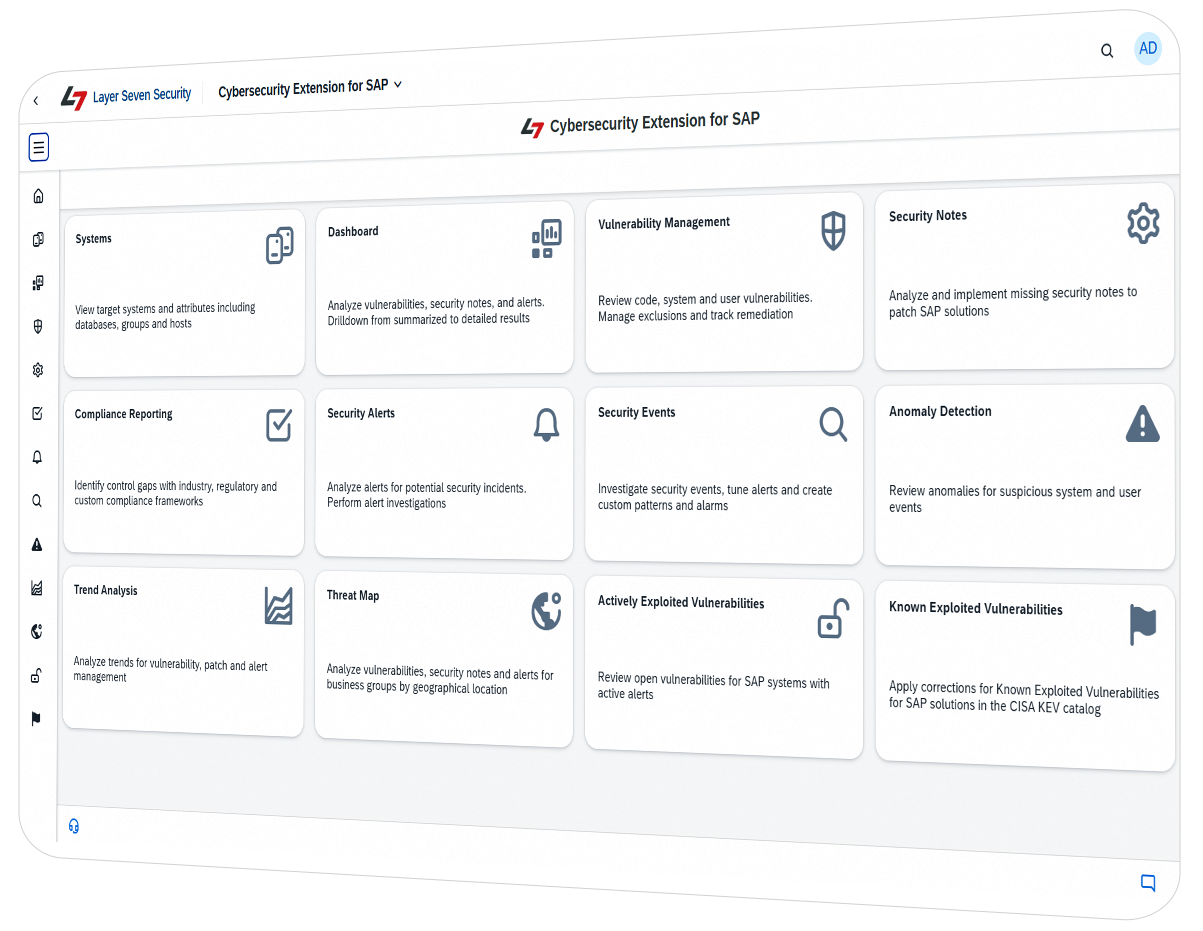
  • SAP system inventory and security posture
  • Access risks and Segregation of Duties conflicts
  • Application, custom-code, database, and host vulnerabilities
  • SAP security notes and patch status
  • Security events, alerts, and incident response
  • Behavioral anomalies and exclusion rules
  • Security dashboards and trends
  • Standard and custom compliance frameworks
Can CES analyze SAP security vulnerabilities?
Yes. CES enables AI assistants to analyze and prioritize SAP security vulnerabilities across applications, custom code, access controls, databases, and hosts using governed, natural-language queries and trusted CES data.
Can CES analyze relevant SAP Security Notes?

Yes. AI assistants can identify, analyze, and prioritize relevant and unapplied SAP security notes by affected system, software version, CVE, CVSS score, available workaround, and processing status.
How does CES support threat detection and response?
CES enables AI assistants to analyze SAP security events, prioritize alerts, identify anomalous user and system behavior, and support guided incident investigation and response using natural-language questions.
Which compliance frameworks can CES analyze?
CES can assess compliance gaps against SAP RISE security requirements, the SAP Security Baseline, the SAP S/4HANA Security Guide, SOX, PCI DSS, NIST, GDPR, and other standard or custom frameworks.
Can users update CES data through their AI assistant?
Yes. CES supports a controlled set of write operations, including alert triage, vulnerability action-plan updates, SAP Security Note status changes, anomaly handling, event exclusions, and custom compliance framework management. Sensitive changes require user confirmation before execution.
Is CES tied to a single AI vendor?
No. MCP is open and model-agnostic, allowing the same CES deployment, security controls, and data source to support multiple AI assistants. Organizations can change or expand their AI platforms without replacing the underlying CES integration.
How is the integration secured?
The Layer Seven Security MCP Proxy shields the MCP Server from direct exposure, authenticates AI clients, and translates credentials according to the selected deployment model. The architecture is predominantly read-only, prevents SAP credentials from being exposed to the AI assistant, and applies confirmation controls to sensitive changes.
Are AI interactions logged and auditable?
Yes. MCP requests, tool calls, and authentication or authorization denials are logged. Correlation identifiers support end-to-end tracing from the AI assistant through the proxy and MCP Server to SAP.
Can CES be deployed in the cloud or within the corporate network?
Yes. CES supports deployment on SAP BTP for cloud-hosted AI platforms or within the customer’s corporate network. The self-hosted model can operate without SAP BTP, Destination Service, or Cloud Connector and can keep SAP security data inside the corporate perimeter.
What authentication options are supported?
Depending on the deployment, CES supports API-key authentication, OAuth 2.0 client credentials, a shared SAP technical user, per-user Basic Authentication relay, SAP OAuth through SOAUTH2, and SAP Principal Propagation.
Does the AI assistant access a separate copy of CES data?
No. The AI assistant provides a conversational interface to the same governed CES services used by the product itself. This avoids creating a separate data path that could become inconsistent with the primary platform.
Can CES data be combined with other AI-agent capabilities?
Yes. Where the selected AI agent has access to other approved tools, CES results can support broader workflows such as creating spreadsheets and reports, preparing executive briefings, distributing findings, creating tickets and change requests, initiating remediation activities, or integrating SAP security intelligence into other enterprise processes.

Cybersecurity Extension for SAP

The Cybersecurity Extension for SAP delivers holistic security including vulnerability management, patch management, custom code security, threat detection and response, and compliance management for SAP solutions
Case Study Indivior

Request a Demo

Schedule a live demo of the industry-leading Cybersecurity Extension for SAP
Request a Demo of Cybersecurity Extension for SAP