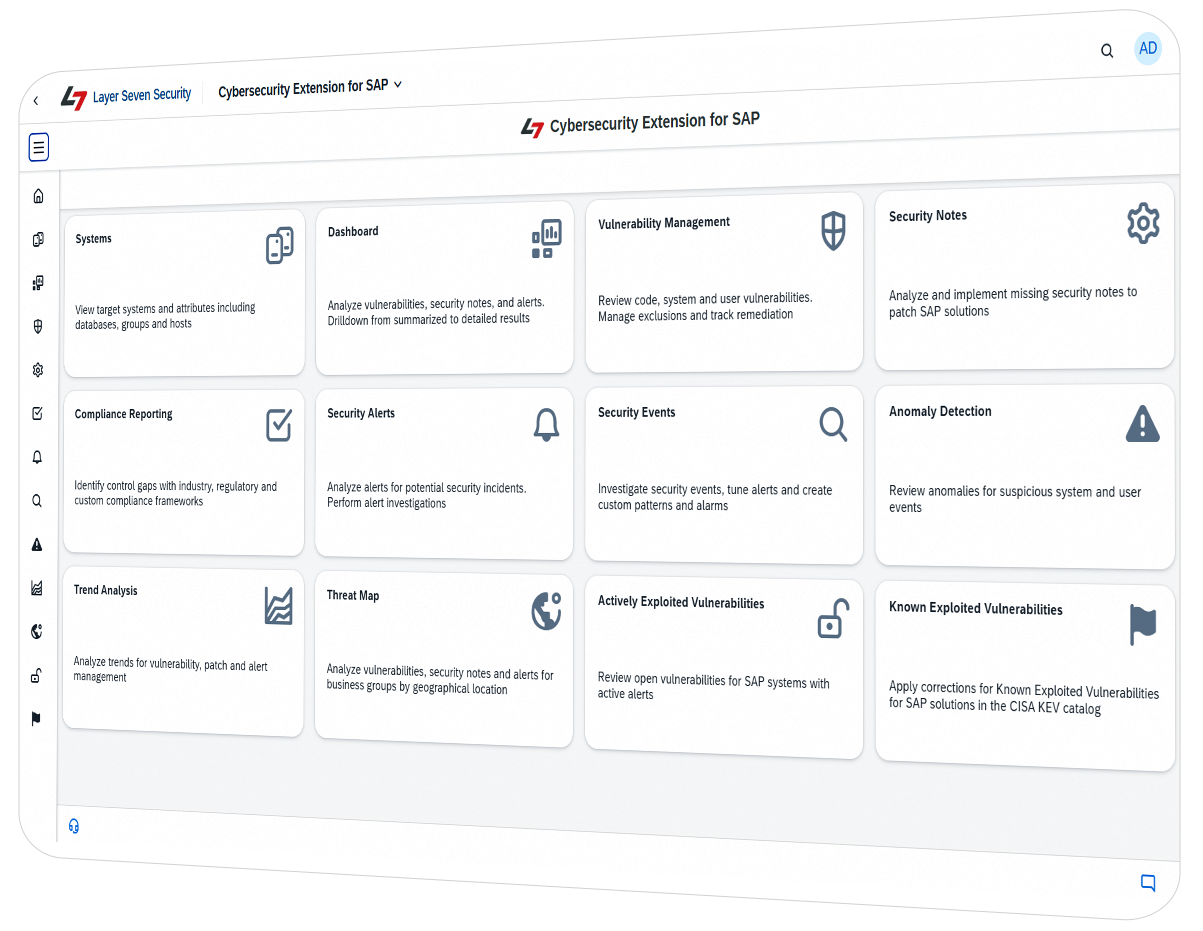
Mitigate SAP vulnerabilities when security notes and support packages cannot be applied through standard support channels.
Third-party support for SAP can reduce maintenance costs and extend the lifecycle of SAP solutions such as SAP ECC, particularly for organizations that choose not to migrate to SAP S/4HANA. However, it can also create security challenges when organizations lose access to standard SAP maintenance channels, including SAP security notes and support packages. Without direct access to official patches and correction instructions, customers may be unable to remediate newly discovered SAP vulnerabilities. This can leave business-critical SAP systems exposed to known security weaknesses and increase the risk of cyber attacks, data breaches, and business disruptions.
The Cybersecurity Extension for SAP enables organizations to reduce these risks through virtual patching. The solution analyzes installed SAP software components and versions to identify relevant CVEs and determine which vulnerabilities apply to each system. When official corrections cannot be implemented, it provides predefined workarounds and compensating controls to help reduce exposure. This includes access restrictions, configuration hardening, deactivation of vulnerable objects, network-level controls, and enhanced monitoring. The solution also provides detection patterns for SAP CVEs, allowing organizations to identify potential exploitation attempts for SAP vulnerabilities and forward alerts to SIEM platforms for SOC monitoring. This enables organizations using third-party support models to secure SAP solutions without access to SAP security notes and support packages.
Third-party support for SAP solutions can significantly reduce ongoing maintenance costs while enabling organizations to extend the operational lifespan of legacy platforms such as SAP ECC. This is particularly attractive for enterprises that have decided to defer or avoid migration to SAP S/4HANA, allowing them to preserve existing investments, maintain business continuity, and redirect budget toward other strategic initiatives without being constrained by SAP’s standard support timelines.
However, transitioning to third-party support can introduce significant security risks, particularly increased exposure to SAP vulnerabilities that are addressed through regular SAP security notes and support packages, which may no longer be accessible to customers that do not have an active SAP support contract.
Reduced access to SAP security notes, support packages, and kernel updates for known vulnerabilities in SAP solutions.
Compliance risk due to failure to comply with audit and regulatory requirements for patching business-critical solutions.
Loss of access to SAP security tools for vulnerability management and security monitoring within Solution Manager and Cloud ALM.
Virtual patching is a proven method for mitigating vulnerabilities without applying vendor patches, allowing organizations to manage known security risks through compensating controls implemented across multiple domains.
Block access to vulnerable components using network and host-level firewalls.
Harden system parameters and disable or remove vulnerable endpoints, protocols and services to minimize the attack surface.
Restrict access to authorizations, transactions, accounts and other privileges required for vulnerability exploitation.
Organizations can materially reduce their exposure to security risks associated with third-party SAP support risks by deploying the Cybersecurity Extension for SAP. The SAP-certified solution delivers continuous vulnerability visibility, enables virtual patching for SAP CVEs, and provides detection and response capabilities to counter exploitation attempts.
Real-time monitoring to detect and alert for the signature of exploit attempts associated with known SAP vulnerabilities. Automated workflows for incident response with integration with service desk and SIEM solutions.
Virtual patching is a security approach that mitigates SAP vulnerabilities without applying SAP-delivered code fixes. Instead of modifying SAP applications, organizations implement compensating controls, such as configuration hardening, access restrictions, and monitoring, to reduce the risk of exploitation.
Organizations operating under third-party support often lack access to SAP security notes and patches. Virtual patching provides a practical and effective way to reduce exposure to known SAP vulnerabilities by implementing controls that prevent or limit exploitation, helping maintain a secure posture despite the absence of SAP updates.
The Cybersecurity Extension for SAP supports virtual patching by:
This ensures vulnerabilities are actively mitigated even when code-level fixes are not applied.
No. Virtual patching does not eliminate vulnerabilities. It reduces their exploitability. While it is a critical compensating control, it should be combined with ongoing monitoring, access control, and risk management to provide a comprehensive security strategy.
The Cybersecurity Extension for SAP uses pattern-based threat detection and behavioral analysis to identify exploit attempts, including:
These capabilities enable real-time detection and response to active threats.
Virtual patching controls for SAP systems may include:
The Cybersecurity Extension prioritizes vulnerabilities based on:
This risk-based approach ensures that organizations address the most critical exposures first.
Yes. Virtual patching supports compliance by demonstrating:
This helps organizations align with frameworks such as NIS2, ISO 27001, and SOX, particularly when vendor patching is not available.
While SAP Solution Manager and SAP Cloud ALM provide native monitoring and vulnerability management capabilities, access to their full functionality may be limited under third-party support. The Cybersecurity Extension for SAP provides an independent and continuously updated capability for vulnerability detection, virtual patching, and threat monitoring, ensuring consistent protection regardless of SAP support status.
Yes. Virtual patching is applicable across:
The approach is particularly valuable in complex or hybrid landscapes where patching may be delayed or constrained.
Virtual patching can be deployed rapidly compared to traditional patching because it does not require system downtime. With the Cybersecurity Extension for SAP, organizations can begin identifying and mitigating vulnerabilities almost immediately after deployment.
The benefits of virtual patching for SAP include:
Learn how a global manufacturer using third-party support secured business-critical SAP systems with virtual patching from Layer Seven Security.
Schedule a live demo of virtual patching with the industry-leading Cybersecurity Extension for SAP.
"*" indicates required fields